

Summary
Casey’s General Store is a convenience store with self-serve gas stations that specializes in small towns across the Midwest. Casey’s has built a distribution and operating model that allows it to profitably serve communities that are too small to attract larger competitors. Casey’s stores differentiate themselves by offering fuel and a wide selection, including groceries, auto parts, and fresh food. Close to 81% of their stores are in towns with fewer than 20,000 people, with 56% in towns with fewer than 5,000 people.
Casey’s primary advantage is their logistical infrastructure. Casey’s owns three distribution centers and their own fleet, which allows it to stay profitable while serving smaller towns.
The business appears to benefit from favorable working capital dynamics, with a substantial portion of inventory financed through supplier credit. Inventory has been steadily increasing over the past decade, and the accounts payable-to-inventory ratio has averaged roughly 1.27, while operating working capital has remained close to zero or negative. This is a significant advantage because they can fund operations with minimal cash investment.


The 5 and 10-year CAGRs for revenue are 12% and 7%, respectively. Most of that growth comes from acquisitions and new construction, as they acquired 235 stores and built 35, while same-store sales grow only a little each year.


The 5-year ROIC is 12%, and incremental ROIC is just 7.2%, which may indicate diminishing reinvestment opportunities, but additional research would be required to be sure about what’s causing the decrease, whether it’s temporary investment spending, acquisition integration, or simply weaker investing opportunities.
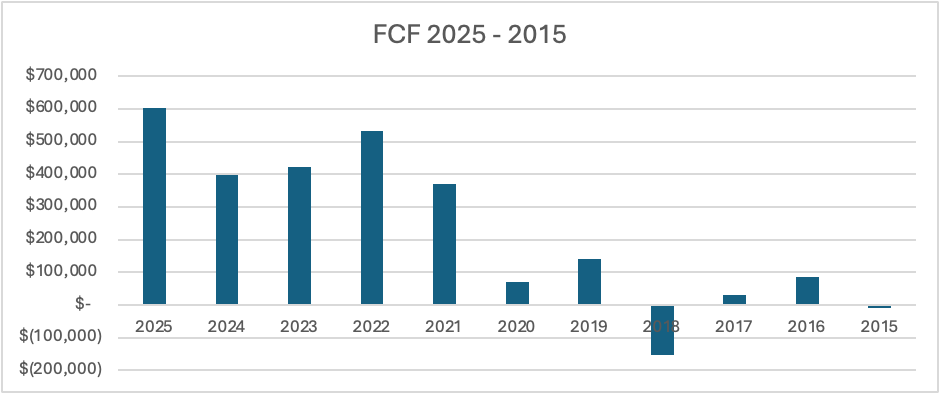
Free cash flow has substantially improved in the past 5 years, and the free cash flow conversion has been between 0.8 and 1.5.

Risks:
What concerns me is the industry’s highly competitive nature. It’s difficult to differentiate outside of location, operational efficiency, and scale. If Casey’s logistics advantage shrinks or competitors improve their economics in smaller markets, returns on future investment could diminish.
Conclusion:
Casey’s seems to be a good business with meaningful competitive advantages. Its logistics infrastructure and favorable working capital dynamics allow it to serve smaller communities profitably. However, growth is primarily acquisition-driven, and incremental returns on capital are not high enough to justify further research at this time. I’m going to put Casey’s on a watchlist, keep an eye out for improving returns, and reassess if the time comes.