

Share Price: $358
Summary
· AI and new competition pose the biggest threats to QuickBooks and TurboTax
· Management likes to move goal posts
· The future is too blurry to be able to forecast reliably
Intuit operates four separate segments:
Global Business Solutions – This segment serves small and mid-market businesses globally. The products primarily include QuickBooks, Intuit enterprise suite, and Mailchimp.
Credit Karma - Targets consumers looking for financial products with personalized recommendations.
ProTax - Serves professional accountants in the US and Canada, helping with tax preparation and filing.
Consumer – Serves consumers directly by helping customers get their taxes done through TurboTax products.
I’m skeptical about Intuit because I’m not sure what the landscape is going to look like in 10 years with AI now in the picture, but I decided to take a look anyway. I quickly realized QuickBooks’s competitive advantage is a bit more involved than just being the software small businesses like to use. Their advantage comes from it acting as the foundation for modern accounting in the US. The platform is taught in most universities, if not all of them, and employers expect accountants to know how to use the program. When businesses use an outside accountant, that accountant will charge the business a fee if they don’t use QuickBooks for the inconvenience of learning new software, if they choose to offer them their services at all. The professional accountants have a huge influence on the software businesses use (the same ones that were taught to use QuickBooks in school).
The nature of the business is naturally sticky. Revenue is subscription based, and businesses tend to stick with their current system once it’s set up. QuickBooks is benefiting from serious customer captivity advantages, businesses and accountants are likely to keep using and recommending the software even if something better comes along. This was summed up on episode 385 of The Accounting Podcast: ‘no one gets fired for recommending QuickBooks’ referring to professional accountants.
Still, AI worries me because the technology is only going to lower switching costs and may eventually become frictionless.
Free cash flow has been growing healthily but slowing slightly. QuickBooks’s FCF is probably slightly understated because management disclosed Mailchimp’s revenue has declined slightly the past two years instead of the slight increase in my model. I left it as is because 1. It doesn’t make a material difference, and 2. It’s additional conservatism. I’d rather undershoot the number a little than try to be precise.
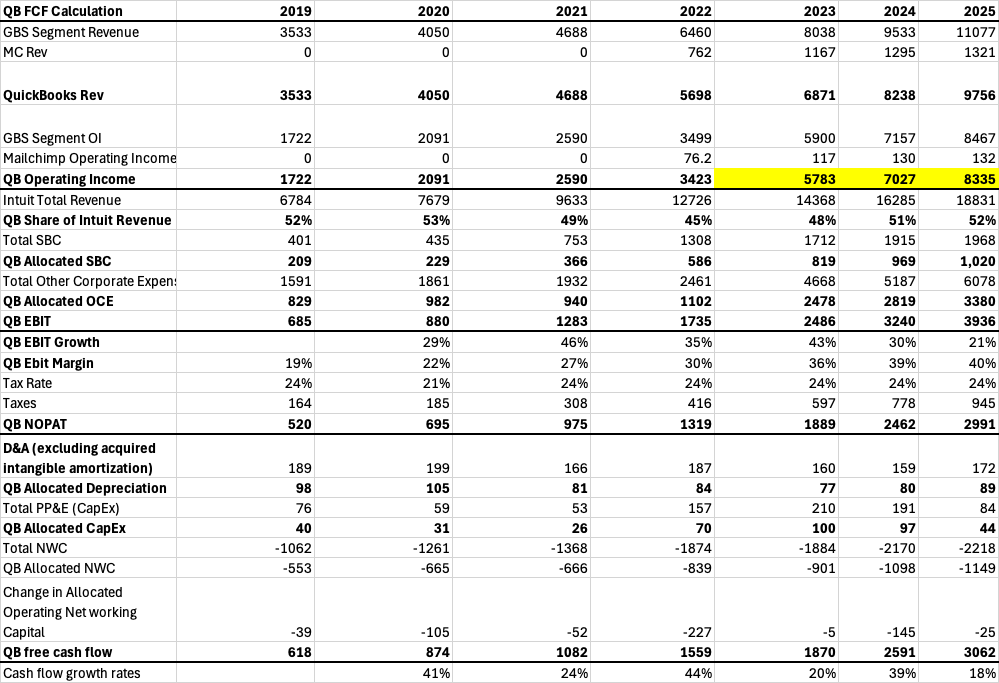
GBS = Global Business Solutions
MC = Mailchimp
OI = Operating Income
SBC = Stock-based Compensation
NWC = Net Working Capital
The yellow highlighted cells for QuickBooks operating income for 2023 through 2025 are highlighted because management removed certain technology and customer success functions from segment operating income and put them in Other Corporate Expenses. As a result, those three years are obviously not comparable to the previous four, but the figures were adjusted for with my best judgment to calculate FCF.
Management attributes Global Business Solutions growth to higher overall effective prices and mix shift. They mention customer acquisition, but the numbers suggest it’s not as impactful. I would expect this growth to slow down meaningfully sometime soon because they’ll eventually hit the wall with price increases and run out of people they can convert.

The cells on the right are highlighted because 2024 is the year they stopped disclosing QBO customers. Instead, online ecosystem growth is disclosed. 2024 and 2025 reported 6% and 5% growth respectively, so I estimated that QBO was responsible for roughly half. Interesting that management decided to make customer growth opaque just as it slowed.
International revenue is growing moderately. The annual report discloses that for the years 2025, 2024, 2023, and 2022, international revenue made up 8% of total revenue. In 2021, 2020, and 2019 it was 5%, 4%, and <5%. Recently, international revenue as a percent of total revenue has stayed flat but total Intuit revenue has been compounding at double digits. Something to keep an eye on.

QuickBooks Online customer retention was disclosed in 2018, 2019, 2020 as 79%, 79%, and 77% respectively. It’s up to the reader to believe whether this omission is meaningful. I would be pessimistic. It’s been my read that management likes to talk about things that are going well and avoids the things that aren’t.
TurboTax has enjoyed a strong market share for a long time but now they’re facing new competition. Management is open about losing on price for the most sensitive DIY filers earning less than $50,000 a year. This is an important group because they make up their next generation of paying customers. Giving that up is accepting a worse decade for better metrics today. Free filers switching software causes the average revenue per user (ARPU) to increase because nonpaying filers are still included in the denominator. In short, management can report better numbers while the business performs worse. You can see below the difference between paying ARPU growth and Total ARPU growth.
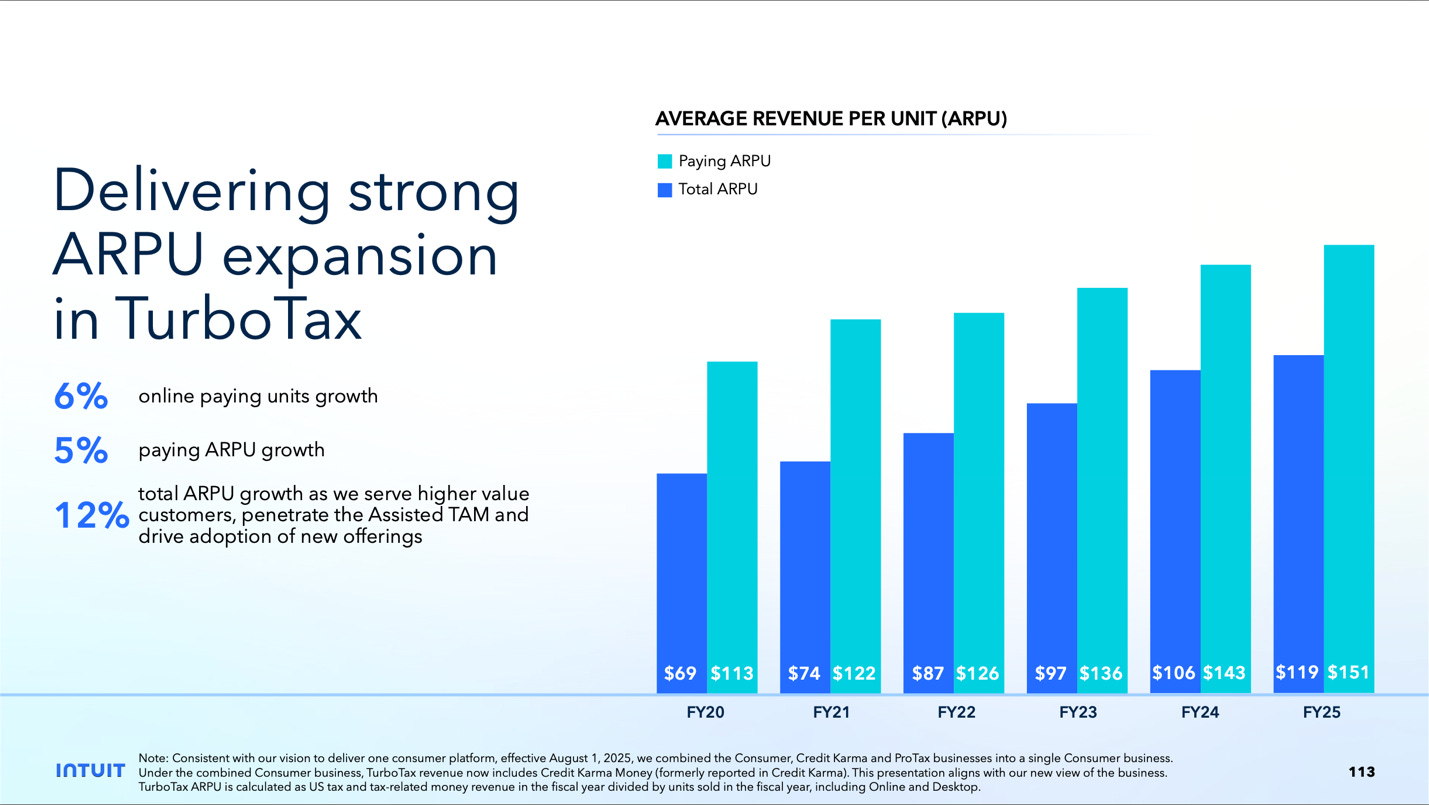
*2025 investor day slide deck
Mailchimp hasn’t been performing well recently either. After the acquisition, Intuit reported segment results both including and excluding Mailchimp’s performance and later stopped disclosing the ‘excluding Mailchimp’ numbers after the acquisition lapped.
As revenue has been regressing, the “excluded Mailchimp” segment numbers have returned. I guess so that Mailchimp doesn’t suppress the numbers too much.
Since Mailchimp’s underperformance, management stated that they are committed to turning the business around double digits. From the Q1 2026 earnings call “We continue to target double digit growth for Mailchimp exiting fiscal 2026. We’re seeing strong results from our mid-market sales team within Mailchimp, with several recent larger customer wins, as well as increasing retention rates in the mid-market segment.”
But in Q2 2026 they “now expect Mailchimp to return to double-digit growth some time beyond fiscal 2026.” I wonder what happened.
--Postscript, August 25, 2026. Intuit reported fiscal 2026 results three days after I finished this. Starting fiscal year 2027, management will stop excluding share-based compensation from non-GAAP earnings to better reflect their operating business. Not many managements would volunteer that change, especially in the same release as a guidance cut. QuickBooks online accounting revenue grew 23% but total online paying customers grew only 3% for the year. Growth is coming from price increases not customer acquisition, which is the strategy I expect will lose steam. Guidance expands on this. Fiscal 2027 revenue growth is expected to be between 9% and 10% compared to the 14% they just reported. TurboTax is expected to grow 2% to 3% with management committed to winning back price-sensitive filers by “making the entry experience more competitive and clear on price.” Mailchimp will also be reported separately from Global Business Solutions with guidance expected between -1% and 0%.
Conclusion
At the end, I decided to keep most of my attention on TurboTax and QuickBooks because they’re responsible for roughly 80% of the company’s revenue. Mailchimp, Credit Karma, and ProTax wouldn’t have changed my decision. Although QuickBooks has been an incredible business in the past, I simply can’t see far enough to value either QuickBooks or TurboTax. It’s just too hard. Next time I’ll stick with my gut and stick to industries that I understand better that are less likely to be uprooted by technology. For now, I’m not interested at any price.