

Introduction
MYRG Group is an electrical construction provider holding company operating in Canada and the United States that serves the electric utility infrastructure and commercial & industrial construction markets. They specialize in design, engineering, procurement, construction, upgrades, maintenance, and repair services, with a particular focus on construction.
They operate through two business segments:
• Transmission and Distribution, servicing electric transmission and distribution networks, and substation facilities
• Commercial and Industrial, providing electrical contracting services for commercial and industrial clients
Each segment serves different customers:
• T&D: big players in the electric utility industry, including investor-owned utilities, cooperatives, private developers, government-funded utilities, independent power producers, independent transmission companies, industrial facility owners, and other contractors
• C&I: general contractors, commercial and industrial facility owners, governmental agencies, and developers
How does this business actually make money?
Jobs are awarded through a bidding process. For larger and more complicated jobs, financial strength and clients’ confidence that MYRG will remain solvent during the job are increasingly important. The company’s strong financials and low debt levels go a long way toward that and allow the company to obtain adequate surety bonds that smaller companies don’t have access to.
Competitive Advantages
I’ve identified two advantages:
1. Their financial strength. MYRG has low debt levels and recently significantly more free cash flow. This allows them to bid on more complicated and larger jobs that smaller contractors don’t have access to. They’re also able to acquire larger surety bonds, which are paramount for securing large projects.
2. They have a centralized fleet management group. This is an internal group responsible for dispatching trucks and equipment to different subsidiaries. This allows them to save on rental costs, improve asset utilization, and eliminate waste.
Although these advantages are real, financial strength and benefits of scale can be copied by successful competitors.
Industry Tailwind
The specialized electrical contracting business is a cyclical industry. Data center construction, grid spending, and transmission investment are all increasing, and the rising tide seems to be raising all boats. After researching MYRG’s competitors, I found that they all showed very similar improvements over the same timeline, and because of that, I believe these improvements are not company-specific and are a result of increased demand across the overall industry.
MYRG's ROIC before 2020 was never higher than 9%. Since then, it’s averaged 15% and has reached as high as 19%.

IES Holdings is a similar story. Prior to 2020, ROIC was in the mid-teens on average and has recently reached levels of 45%.

Comfort Systems USA, prior to 2020, had an average ROIC of roughly 20% and has since reached 61%.

Margins throughout the decade have stayed roughly flat. I interpret this to mean that the industry is benefiting from higher demand, and businesses are enjoying higher asset utilization of their equipment, leading to higher returns on capital.
Capital Allocation
In the past decade, MYRG has spent $264 million on acquisitions. Net income increased from $21 million to $118 million. Revenue increased from $1.1 billion to $3.6 billion, and goodwill grew from $46 million to $115 million. They’ve done all of this while keeping shares outstanding roughly flat. The amount of revenue growth relative to acquisition spending suggests that the majority of growth has been organic.
Financial Characteristics
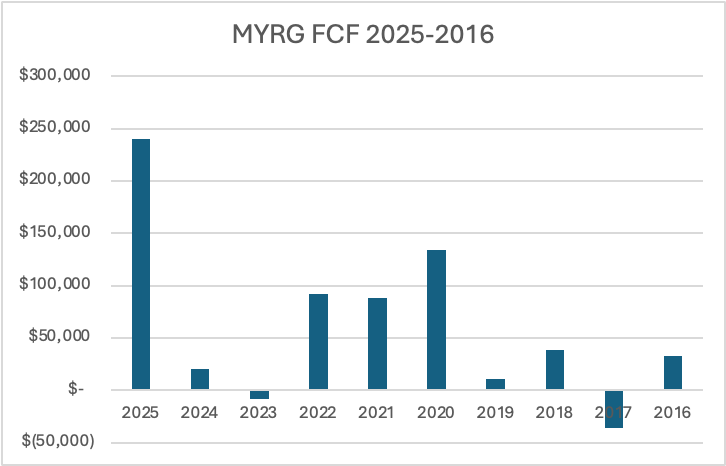
Revenue is growing healthily. The company has more than tripled its revenue over the past decade with a 10-year CAGR of 12%, and an 8.8% 5-year CAGR. MYRG has also realized an increase in free cash flow; however, it is less consistent than I would like to see. The upward trend is driven by three very strong years from 2020 to 2022 and 2025 as an exceptionally strong year, while the other six years generated low or negative cash flow. Overall, the business looks like it’s improving, but likely because of improving industry conditions.
Gross margins have been stable at around 10%.
Debt levels are conservative. For the past five years, total debt to shareholders’ equity has been less than 20% on average, and total debt to EBIT has fluctuated between 50% and 60%.
Risks
The primary risks I’ve realized are:
1. Competition
2. Weakening demand
3. Skilled labor supply
I haven’t found evidence that MYRG is gaining market share, and besides expertise and capital, there isn’t anything keeping outsiders from competing with MYRG. As we’ve seen, the business seems to be benefiting from a booming industry, but I wouldn’t be confident that this elevated financial performance will sustain as new competitors enter the market.
If spending on technological infrastructure, data centers, utilities, industrial construction, and other electrical-related contracting work decreases, then MYRG and similar companies must suffer.
If MYRG must expand significantly to meet new industry demand, skilled labor may become a serious bottleneck.
Conclusion
MYRG seems to be a good business that benefits from a booming industry. The company’s scale advantage allows it to utilize its assets more efficiently and bid jobs at more competitive and accurate rates.
What keeps me from investing more time in researching this business is that I haven't been able to identify a strong moat competitors can’t copy. Also, before the increase in demand, returns on capital stayed below 10%, suggesting the business lacks the pricing power or competitive advantages necessary to generate meaningful returns.
What would change my mind is if I learned that large projects were being concentrated in a small group of contractors, MYRG being one of them, or the only one, with a sustained high ROIC above historical levels after the industry growth normalizes.
For now, this is a pass for me.